
How to Structure an AI Delivery Pod: The Engineering Team Model Built for 2026


Most engineering teams that are serious about AI have already adopted AI coding tools. Some have restructured their code review process. A smaller number have started experimenting with autonomous AI agents for bounded tasks.
Very few have answered the harder question: what does the whole team actually look like when AI is a first-class member of the delivery process — not an add-on tool, but a structural part of how work gets planned, built, tested, and shipped?
That is the question the AI Delivery Pod model answers. It is not a staffing configuration invented in a conference room. It is the practical structure that emerges when engineering teams take AI adoption seriously from first principles — and design their delivery model around what humans and AI agents each do best.
This post explains exactly what an AI Delivery Pod is, how it is structured, what each role does, where the agents sit, and what it takes to operate one well. If you are thinking about how to move from AI experimentation to AI-embedded delivery, this is the architecture.
Why Traditional Team Structures Do Not Scale with AI
The standard software engineering team structure — product manager, tech lead, a handful of developers, a QA engineer, maybe a DevOps resource — was designed for a world where all the work is done by people. Every task, from reading a requirement to writing a test to reviewing a PR, requires a human hour.
AI does not just make those tasks faster. It changes which tasks need to be done by humans at all.
When AI agents can handle code scaffolding, test generation, documentation, PR reviews, and knowledge capture — the bottleneck is no longer writing the code. The bottleneck becomes decision quality: the clarity of the requirements that AI is given, the architectural thinking that shapes what gets built, and the human judgement that validates what AI produces.
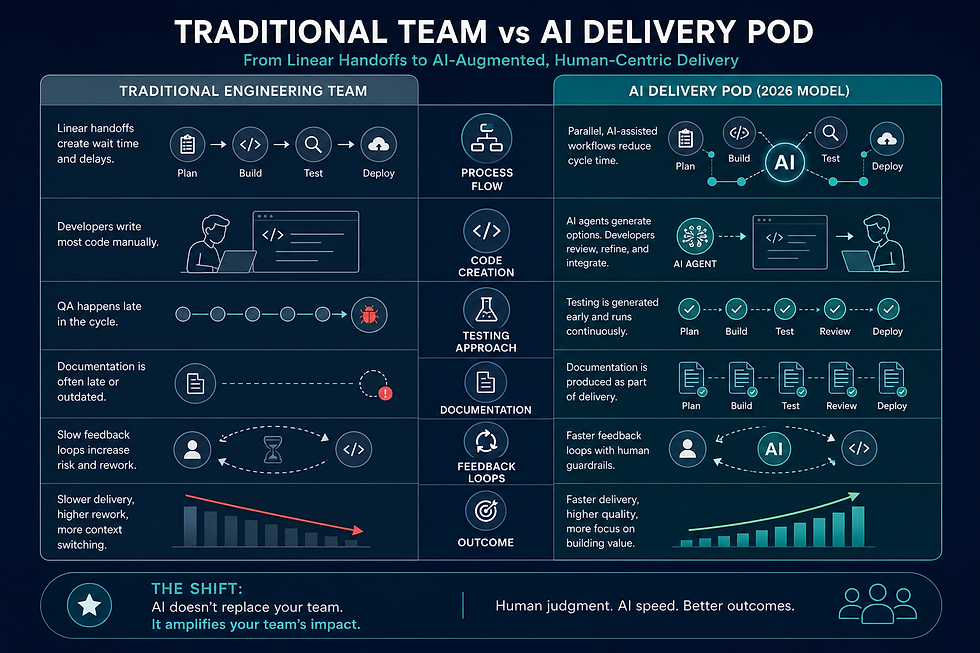
Traditional team structures optimise for output volume. AI Delivery Pods optimise for decision quality and delivery leverage.
The difference is not subtle. A team using AI tools inside a traditional structure will get a moderate productivity boost. A team restructured around an AI pod model gets compounding leverage — faster delivery, more consistent quality, and a knowledge base that gets smarter over each project cycle.
What an AI Delivery Pod Is
An AI Delivery Pod is a small, outcome-focused delivery unit in which AI agents are embedded at every stage of the software development lifecycle — not bolted on at the edges, but woven into how the team plans, builds, tests, and learns.
A pod is not a large team. It is deliberately compact: typically four to six humans, supported by a set of AI agents that handle the high-volume, repeatable, and context-dependent tasks that would otherwise consume human time. The humans in the pod own the decisions. The agents execute the work that feeds and follows those decisions.
The analogy that works best is not a team with AI tools. It is a Formula 1 pit crew. Each person has a defined role, operates in tight coordination, and hands off precisely. The AI agents are the automated systems embedded in that workflow — the telemetry, the tyre pressure monitoring, the simulation modelling. They do not replace the crew. They remove the noise so the crew can focus on what only they can do.

The Anatomy of an AI Delivery Pod
A fully structured pod has two layers: the human roles and the embedded AI agents. They are not separate — they operate in an integrated workflow.
The Human Roles
Human Roles in an AI Delivery Pod
Role | What They Own | What AI Takes Off Their Plate |
Tech Lead / AI Architect | Architecture decisions, system design, agent configuration, quality gates | Boilerplate implementation, PR initial review, documentation drafts |
Senior Engineer (1–2) | Business logic, complex feature ownership, code review final sign-off | Unit test scaffolding, refactoring suggestions, code search across codebase |
Delivery Lead | Sprint planning, stakeholder communication, backlog quality, delivery metrics | Requirement decomposition, task breakdown, progress summarisation |
QA / Validation Engineer | Acceptance criteria, exploratory testing, defect triage | Test case generation, regression suite execution, issue reproduction steps |
Domain Specialist (optional) | Industry or product domain expertise, compliance judgement, user context | Research summaries, competitor analysis, documentation review |
Two things are notable about this structure. First, it is lean. A pod this size, operating with embedded AI agents, can carry the throughput of a traditional team twice its size. Second, every human role is weighted toward decisions, judgement, and ownership — not execution of tasks that can be systematised.
The AI Agent Layer
The four agent types in a pod each operate at a specific point in the delivery cycle. They are not general-purpose AI assistants that developers occasionally prompt. They are configured, deployed, and integrated into the team's workflow.
The Four AI Agent Types
Agent Type | Where It Operates | Core Functions | Human Handoff Point |
Planning Agent | Sprint planning, backlog refinement, requirements intake | Breaks epics into user stories, writes Given/When/Then acceptance criteria, identifies dependencies, flags ambiguity | Delivery Lead reviews and approves output before sprint starts |
Builder Agent | Development cycle | Code generation, refactoring, documentation, PR descriptions, boilerplate elimination | Senior Engineer reviews logic, architecture decisions, and edge case handling |
QA Agent | Testing and validation | Test case generation, regression execution, issue reproduction, accessibility checks | QA Engineer owns acceptance tests, exploratory testing, and final defect triage |
Knowledge Agent | Across the full project | Captures decisions, documents patterns, logs lessons learned, maintains project context across sprints | Tech Lead reviews and curates; output feeds future sprint planning |
What makes this model work is not the individual agents in isolation — it is the handoff protocol between them and the humans in the loop. Each agent produces structured output that a human validates before it flows to the next stage. The agents compress the time between stages; the humans ensure the direction is right.
How Work Actually Flows Through the Pod
The abstract model is useful. The concrete workflow is what makes it real.
Here is how a single feature moves through a fully operational AI Delivery Pod:
1. Intake → Planning Agent A product requirement or epic enters the backlog. The Planning Agent reads it, breaks it into user stories with clear acceptance criteria, identifies which stories have external dependencies, and flags any requirements that are ambiguous or underspecified. This output lands in a structured format ready for sprint review.
2. Sprint Review → Delivery Lead + Tech Lead Two humans review the Planning Agent's output. The Delivery Lead validates priorities, estimates, and stakeholder alignment. The Tech Lead reviews the technical breakdown and flags architectural decisions that need a human design call before implementation begins. Any stories that require a design session are pulled aside — AI does not implement what has not been architecturally decided.
3. Implementation → Builder Agent + Senior Engineers Well-defined stories go to the Builder Agent for initial implementation. The agent generates code, writes PR descriptions, creates inline documentation, and flags decisions it made that may need human review. Senior Engineers review the output, handle the complex logic the agent cannot own, and make architecture decisions in real time. The agent is a multiplier for their output, not a replacement for their thinking.
4. Testing → QA Agent + QA Engineer The Builder Agent's output passes to the QA Agent, which generates test cases based on the acceptance criteria, runs the regression suite, and produces a structured report of any failures. The QA Engineer runs exploratory testing against the feature, validates that the acceptance tests cover the real business intent — not just the happy path — and owns the sign-off decision.
5. Retrospective → Knowledge Agent At the end of each sprint, the Knowledge Agent pulls the decision log, captures lessons learned, documents any new patterns introduced to the codebase, and updates the project context store. This output feeds back into the Planning Agent for the next sprint — so the pod gets smarter with every cycle.
The Pod in Numbers: What to Expect
One of the most common questions about this model is practical: what does it actually deliver, and how does that compare to a traditional team?
The honest answer is that results depend heavily on implementation quality — specifically, how well the agents are configured, how clearly the backlog is maintained, and how disciplined the handoff protocols are. Poorly configured agents inside a pod model deliver worse results than a well-run traditional team.
With proper implementation, the pattern we see consistently is:
AI Delivery Pod vs. Traditional Team — Typical Delivery Metrics
Metric | Traditional Team | AI Delivery Pod | Change |
Cycle time per user story | 3–5 days | 1–2 days | ~60% reduction |
Test coverage on new features | 50–70% (manual) | 85–95% (agent-assisted) | Significant improvement |
Documentation currency | Typically 1–2 sprints behind | Updated each sprint | Always current |
Sprint planning time | 3–5 hours per sprint | 1–1.5 hours per sprint | ~65% reduction |
Knowledge retention across projects | Low — lives in people's heads | High — captured systematically | Structural improvement |
Ramp-up time for new engineers | 2–4 weeks | 3–5 days | ~75% reduction |
These are directional benchmarks, not guarantees. The largest gains typically appear in cycle time and planning efficiency within the first two sprints. The knowledge retention and ramp-up improvements compound over time — they are not immediately visible but become significant advantages over longer projects and across multiple engagements.

The Three Things That Make or Break a Pod
Most pod implementations that underperform fail for one of three reasons. Understanding them in advance is the difference between a model that delivers and one that frustrates.
1. Backlog quality is the foundation
AI agents are amplifiers. They amplify good input into great output. They amplify vague input into plausible but wrong output — fast. A Planning Agent working from poorly written requirements will generate beautifully formatted user stories that implement the wrong thing. No agent can compensate for requirements that were never properly defined.
The discipline required before deploying a pod is investing in backlog quality. Every story needs clear business context, unambiguous acceptance criteria, and a definition of done that a non-expert could evaluate. This is not new discipline — it is the discipline most teams mean to apply but deprioritise under pressure. AI makes skipping it more expensive than ever.
2. Human decision points must be protected
The natural pressure in any delivery environment is to accelerate. When agents are producing output, the temptation is to let that output flow directly to the next stage without meaningful human review — because it looks complete, it looks professional, and there is always another ticket waiting.
This is the single most common failure mode in pod implementations. Approved outputs that carry hidden errors or architectural drift compound sprint over sprint. The humans in the pod are not there to rubber-stamp agent output. They are there to make the decisions that agents cannot make: is this the right thing to build, is the architecture coherent with the rest of the system, and does this work meet the actual business intent?
Protecting those human decision points — building them into the workflow, not treating them as optional gates — is what separates pods that deliver quality from pods that produce volume.
3. The Knowledge Agent is not optional
Teams new to the pod model often treat the Knowledge Agent as the lowest priority. Planning, building, and testing feel more urgent. Documentation and lesson capture feel like housekeeping.
This is the right instinct applied to the wrong context. In a traditional team, lesson capture is genuinely low-value because it mostly produces documents no one reads. In a pod model, the Knowledge Agent's output directly feeds the Planning Agent's context for the next sprint. The quality of sprint two's planning is partially determined by how well sprint one's knowledge was captured. Teams that skip this step run each sprint from scratch. Teams that maintain it run each sprint from a continuously improving baseline.
Fitting the Pod Into Your Organisation
An AI Delivery Pod is not a standalone island. It operates inside a broader organisational structure, and how it connects to that structure matters.
Pod Integration Patterns
Organisational Context | Recommended Pod Configuration | Key Integration Points |
Startup / scaling product team | Single pod covering full product delivery | Direct alignment with CEO/CPO on backlog; pod owns the stack end-to-end |
Mid-size engineering team (20–50 engineers) | 2–3 pods per product domain, shared Knowledge Agent | Cross-pod architecture sync; shared pattern library; unified QA standards |
Enterprise (50+ engineers) | Pod per squad, with Fractional AI CTO overseeing agent configuration and governance | Central AI governance layer; standardised agent tooling; compliance integration |
Consulting / delivery partner | Client-embedded pod with client Delivery Lead | Weekly stakeholder review; client access to planning output; IP and knowledge handoff protocol |
The governance layer above the pods is as important as the pods themselves in larger organisations. Without it, each pod configures its agents differently, develops its own patterns, and the organisation ends up with the same fragmentation problem that unstructured AI adoption creates — just at the pod level instead of the individual level.
Getting Started: What the First 30 Days Look Like
Transitioning to a pod model does not require a complete organisational restructure. It requires a disciplined pilot.
Days 1–7: Baseline and selection Choose one existing team and one project with a well-defined backlog. Do not pilot on your most critical production system. Audit the backlog for quality — rewrite stories that lack clear acceptance criteria. Identify and onboard the four agent types with appropriate tool access and configuration.
Days 8–14: First sprint in pod configuration Run the first sprint with the full pod workflow. Expect friction — the Planning Agent output will need significant human correction initially, as the agent learns the domain and backlog patterns. This is normal. Document the corrections; they will feed the Knowledge Agent's initial context store.
Days 15–21: Calibration Review the first sprint retrospective with the Knowledge Agent output alongside the human retrospective. Identify which agent handoffs worked smoothly and which required excessive human correction. Adjust agent prompting, context, and scope accordingly.
Days 22–30: Measurement and decision Run the second sprint. Compare cycle time, defect rate, and planning time against your pre-pod baseline. By day 30, most teams see clear directional improvement in at least two of the three metrics. Use this data to decide whether to expand to a second pod or continue optimising the first.
The temptation at this stage is to expand too quickly. Resist it. A second pod that copies the first pod's setup before the first pod's lessons are fully captured will repeat the same calibration problems. Let the Knowledge Agent do its job before you scale.

What Cluedo Tech Has Learned
Cluedo Tech has designed and operated AI Delivery Pods across engagements in education, logistics, fintech, and enterprise operations. The pattern of insight is consistent across different domains and different team sizes.
The technology is not the hard part. Deploying the agents, configuring the tooling, and integrating the workflow is a solved problem. The hard part is the human side of the model: building the discipline around backlog quality, protecting the decision points under delivery pressure, and committing to knowledge capture when the sprint is running fast.
The teams that have had the strongest outcomes are not the ones with the most sophisticated AI tooling. They are the ones that invested most seriously in the human layer — the clarity of the roles, the integrity of the handoff protocol, and the quality of the inputs they give the agents.
AI amplifies what your team already does. A disciplined team with good practices becomes exceptional. A disorganised team with vague backlogs becomes faster at building the wrong thing.
The AI Delivery Pod model is designed to be the former. It is a structure that makes AI amplification safe, systematic, and compounding — rather than fast, unpredictable, and eventually expensive to unwind.
If you are evaluating whether an AI Delivery Pod model is right for your team or your organisation, Cluedo Tech can help you assess your current setup, design the right configuration, and run the pilot that gives you real data before you commit to the full model.


