
AI Inventory & Video Recognition Platform
The project combined mobile capture, AI object recognition, deduplication thinking, human review, cloud storage, project hierarchy, and export-ready reporting into one practical workflow.
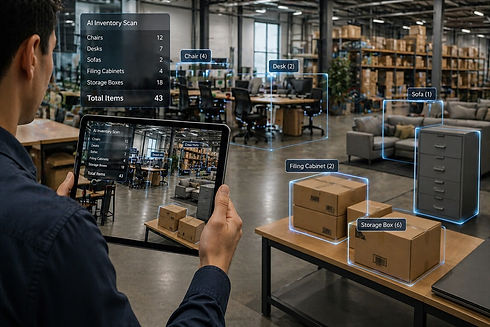
The real challenge was not just recognizing objects. The real challenge was building a complete operational workflow around AI — capture, detection, human review, project organization, export, and future scalability.
Manual inventory collection is slow, inconsistent, and difficult to audit.
Cluedo Tech helped transform this process into a structured AI-assisted workflow where users can capture a space using video or images, let the system identify objects, review the results, and export organized inventory records.
Project Type
AI-powered inventory and asset recognition application
Core Workflow
Capture → Detect → Review → Organize → Export
Users
Field staff, managers, admins, internal operations teams
AI Function
Object detection, categorization, counting, deduplication support
Output
Structured inventory records and export-ready reports
Delivery Role
Product workflow, UX structure, architecture, AI, delivery, modeling, support
The Business Problem
Manual inventory collection is slow, inconsistent, and hard to verify. Field teams often rely on spreadsheets, photos, notes, and memory to document rooms, furniture, equipment, and physical assets.
That creates problems when the inventory has to be reviewed, corrected, shared, exported, or used later for planning and operational decisions.
The client needed more than object recognition. They needed a complete workflow that could turn a site walkthrough into structured, usable inventory data.
Manual Capture
Inventory records depended on slow manual entry, handwritten notes, spreadsheets, and disconnected photos.
No Review Layer
AI output needed a human validation process before it could be trusted for operational use.
Limited Auditibality
Without source images or video, it was hard to verify how an inventory record was created.
Inconsistent Counting
The same object could be missed, counted twice, or categorized differently by different users.
Weak Project Structure
Inventory had to be organized by client, project, site, room, and category — not just stored as raw detections.
Difficulty Exporting
The final output needed to be structured, clean, and usable outside the app.
The core problem was not “Can AI detect furniture?” The real problem was “Can AI help produce a reliable inventory workflow that people can actually use?”
What Cluedo Tech Built
Cluedo Tech designed the platform as a complete AI-assisted inventory workflow — not just an object recognition feature. The system combined video/image capture, AI detection, human review, project organization, cloud storage, and export-ready reporting into one practical application.
Capability
Description
Video & Image Capture

Users capture rooms, offices, storage areas, furniture, equipment, and assets using a mobile or tablet device.
Inventory Review

Users can confirm, edit, delete, or adjust detected items before the inventory is finalized.
Cloud Storage

Captured media, inventory records, project data, and supporting files can be stored securely for later access and review.
AI Object Detection

The system identifies likely objects such as chairs, desks, cabinets, boxes, and equipment from captured media.
Project Organization

Inventory can be organized by client, project, location, room, asset type, and status.
Export-Ready Reporting

Final inventory data can be exported into structured formats for reporting, operations, or downstream systems.
From Site Walkthrough to Structured Inventory
The workflow was designed to turn raw video or image capture into reviewed, organized, export-ready inventory data.
01
Create Project
Managers create the project structure and define the site, room, or inventory scope.
04
Human Review
Users review AI-detected items, correct mistakes, remove duplicates, and approve final records.
02
Capture Space
Field users record video or images of the physical environment using a mobile or tablet device.
05
Export Inventory
Approved inventory data is exported into structured reports for operations, planning, or downstream systems.
03
AI Detection
The system analyzes captured media and identifies likely objects, categories, and draft counts.
AI creates the draft. People control the final record. That balance is what makes the workflow usable in the real world.
Practical Architecture for Real-World AI Workflows
The platform was designed around a practical architecture: capture the physical environment, process it through AI, allow human review, store the results, and export clean inventory records.
User Interface Layer
Mobile / tablet capture + inventory review
Application Layer
Projects + users + roles + inventory records
AI Processing Layer
Object detection + categorization + counting support
Storage Layer
Media storage + inventory data + project records
Output Layer
Exports + reports + operational data
The platform was designed as a workflow system first, and an AI system second.
AI Assistance With Human Control
For business workflows, AI output cannot simply be accepted blindly. The platform was designed so AI produces a draft inventory, while users retain control over the final record. This improves speed without sacrificing accountability.
AI Risk Controls
Object misidentified → User can correct the category before finalizing
Object missed → User can manually add an item
Object counted twice → Review process allows duplicate correction
Low-confidence detection → User can validate before export
Wrong project or room assignment → Inventory can be organized and corrected inside the project hierarchy
Export errors → Final data can be reviewed before it leaves the system
AI should accelerate the work, not remove accountability. The system was designed to keep people in control of the final inventory record.
Business Value Delivered
The project created more than an AI feature. It created a scalable inventory workflow that improves speed, consistency, review, auditability, reporting, and future readiness.
Faster Field Work
Users can capture visual inventory data faster than typing every item manually.
Improved Accuracy
AI-assisted detection plus human review creates a stronger quality-control process.
Cleaner Reporting
Inventory data can be organized and exported in structured formats.
Better Consistency
Standardized capture and review workflows reduce variation between users.
Greater Auditability
Captured media supports review, validation, and future reference.
Scalable Foundation
The platform can evolve toward more users, more object categories, integrations, and client-facing workflows.
Before and After
The project helped turn a manual, fragmented inventory process into a structured AI-assisted workflow with review, organization, and export built in.
Before
Manual notes, photos, and spreadsheets
Slow item-by-item entry
Inconsistent categories and counts
Difficult to verify inventory source
Limited project organization
Manual cleanup before reporting
Hard to scale beyond internal use
After
AI-assisted capture and structured inventory records
Faster video/image-based capture
Standardized detection and review workflow
Captured media connected to records
Client, project, site, room, and item hierarchy
Export-ready structured output
Foundation for broader operational deployment
Result: A manual inventory process became a structured, AI-assisted product workflow.
Cluedo Tech helped transform a raw operational need into a working AI-enabled inventory platform and delivery workflow.
The project created a foundation for capturing physical spaces, identifying furniture and equipment, reviewing AI-generated inventory, organizing records by project, and exporting structured data for operational use.
Most importantly, the system was designed for real-world adoption: AI provides speed, while human review provides control.